Carl, while traveling through the Downtown Tunnel (which goes from Norfolk to Portsmouth): I remember when this went in. It'll never work, they said. Portsmouthers love their ferry. Three months later... (He laughs).
Ellen: It's a lot quicker than a ferry.
Carl: Well, not really. I mean, if you were driving a car you had to line up. But if you were a pedestrian, you just paid your ten cents and walked right on.
Ellen: But this was built when the car was becoming the major source of transportation, right? In the fifties sometime?
Carl: Yeah. Before the war, most people didn't have cars. They took buses or streetcars, or just walked everywhere. But in the fifties... that was really the first era when everyone had cars.

Showing posts with label Portsmouth. Show all posts
Showing posts with label Portsmouth. Show all posts
Wednesday, April 17, 2013

Wednesday, March 13, 2013
Carl's childhood home in Park View
Carl and I drove through Park View in Portsmouth today:
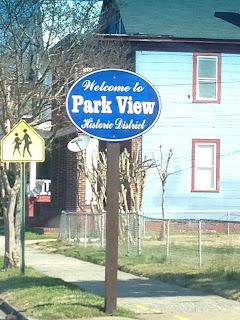 Much of the area was clearly razed in the sixties to make way for brick ranches, but a good many older houses remain, including the one Carl grew up in:
 In this post, he related his first glimpse of a truck. He recalls sitting in the bay window (visible at the right of the house) when he saw it.
While driving around Portsmouth, we also saw Norcom High School. Carl relates:
I went to Wilson. That was the white school. Norcom was right next to it, but it was the black school. Totally separate. They both had football teams, but they never played each other, because white teams didn't play black teams. You really can't believe how... profound the separation was if you didn't grow up with segregation.


While driving around Portsmouth, we also saw Norcom High School. Carl relates:
I went to Wilson. That was the white school. Norcom was right next to it, but it was the black school. Totally separate. They both had football teams, but they never played each other, because white teams didn't play black teams. You really can't believe how... profound the separation was if you didn't grow up with segregation.
Friday, August 17, 2012
Transportation
Carl: A lot of times, to get around, you rode a ferry. You had no bridges; if you went from Norfolk to Portsmouth, or Berkeley, or Newport News, you took a ferry. If you were going west on the Chesapeake and Ohio, which went out of Newport News, you took the ferry boat. They had a fast ferry--steamer, actually, but it was a ferry. Everywhere you went-- if you were going to New York, you took the ferry over to Cape Charles. You traveled by steamboat to these places. You had the Baltimore line-- two lines going to Baltimore-- the Washington line, a Philadelphia line, a New York line, a Boston line, a Charleston and Savannah line-- there were no bridges.
Ellen: When did they start building bridges? Was that one of the things the WPA did in the thirties?
Carl: They actually got into the first bridges during the Roosevelt administration, during the Depression. The Military Highway was built almost entirely by WPA workers. (Note that the Wikipedia link indicates Military Highway was built in 1943 due to the military buildup during World War II. Carl may be conflating two different roads here.) It put a lot of men to work. The Post Office building in downtown Norfolk, that was built by the WPA. I worked there for twenty years, before I went to Portsmouth.
Ellen: Did you ever work for the WPA?
Carl (thinks about it): Somewhere along the line... I went to work for the railroad (first). That was my first really permanent job. I did work some for the WPA, office-type work... Anyway, one of the things that's most different today was the fact that you went nowhere across water except by ferry.
Ellen: Tell me about your first car.
Carl (with sardonic amusement): Oh, my first car was a wonder.... a real dog, I think it was an Essex. I think I paid $35 for it. It had holes in the floor; you could reach down and push yourself along. Holes in the floor where your feet were. That was a real dog.
But the second car I got was fantastic. It was a straight-eight sportscar. Pierce-Arrow, which was the American equivalent of Rolls Royce. That was a real fine car. I got that from-- a young "blade," as we used to call them, and he got married, and his wife insisted he settle down and buy a normal car. So he bought a Buick, or something like that, probably, and sold that car to me for something like $75. Which doesn't sound as cheap as it would be today, because you could buy a new Ford or Chevrolet for $700.
After the war, when I bought my old Chevrolet, I wanted to buy it-- I had a good buy. That was a '48, the last remaining prewar car. It was nothing in the world but a '41, '42-- they discontinued (cars) entirely during the war, made tanks and that sort of thing. When they went back into the business in '47, after the war-- it took them a couple of years to tool up and get going-- they didn't have a new car. They still made the prewar car until about '49, and the first postwar Chevrolets that came out were 1949s. I had a '48, brand new. Well, practically. Guy I worked with bought it, then shortly afterward the '49s came out, and he had to have a new car. So he sold me that thing for a reasonable-- something like $200. Almost brand new. I had that car for a long time, right up till after we were married. (This site suggests Carl's dates are accurate, saying, "In 1949, Chevrolet presented its first all new models since the end of World War II.")
Ellen: When did they start building bridges? Was that one of the things the WPA did in the thirties?
Carl: They actually got into the first bridges during the Roosevelt administration, during the Depression. The Military Highway was built almost entirely by WPA workers. (Note that the Wikipedia link indicates Military Highway was built in 1943 due to the military buildup during World War II. Carl may be conflating two different roads here.) It put a lot of men to work. The Post Office building in downtown Norfolk, that was built by the WPA. I worked there for twenty years, before I went to Portsmouth.
Ellen: Did you ever work for the WPA?
Carl (thinks about it): Somewhere along the line... I went to work for the railroad (first). That was my first really permanent job. I did work some for the WPA, office-type work... Anyway, one of the things that's most different today was the fact that you went nowhere across water except by ferry.
Ellen: Tell me about your first car.
Carl (with sardonic amusement): Oh, my first car was a wonder.... a real dog, I think it was an Essex. I think I paid $35 for it. It had holes in the floor; you could reach down and push yourself along. Holes in the floor where your feet were. That was a real dog.
But the second car I got was fantastic. It was a straight-eight sportscar. Pierce-Arrow, which was the American equivalent of Rolls Royce. That was a real fine car. I got that from-- a young "blade," as we used to call them, and he got married, and his wife insisted he settle down and buy a normal car. So he bought a Buick, or something like that, probably, and sold that car to me for something like $75. Which doesn't sound as cheap as it would be today, because you could buy a new Ford or Chevrolet for $700.
After the war, when I bought my old Chevrolet, I wanted to buy it-- I had a good buy. That was a '48, the last remaining prewar car. It was nothing in the world but a '41, '42-- they discontinued (cars) entirely during the war, made tanks and that sort of thing. When they went back into the business in '47, after the war-- it took them a couple of years to tool up and get going-- they didn't have a new car. They still made the prewar car until about '49, and the first postwar Chevrolets that came out were 1949s. I had a '48, brand new. Well, practically. Guy I worked with bought it, then shortly afterward the '49s came out, and he had to have a new car. So he sold me that thing for a reasonable-- something like $200. Almost brand new. I had that car for a long time, right up till after we were married. (This site suggests Carl's dates are accurate, saying, "In 1949, Chevrolet presented its first all new models since the end of World War II.")
Ellen: What happened to the Pierce-Arrow? Did you sell it when you went to the war?
Carl: I went into the service, and I left that car with somebody I knew, told them to take care of it. They thought I was gone, of course; I mean, when you went in the service-- and he had it a while, and when he got a chance, he sold it up the river. He sold it to somebody who knew the value of it, and he completely restored it, and it was a showcar after the war, at sportscar shows. I mean, it was a showpiece! It had a trunk, and under the second seat was a hole, like that (holds hands a couple of feet apart)-- that was for your golf clubs. It had wire wheels, something like twenty-two inches. Straight-eight. The two spare wheels were in wells on either side-- you've seen pictures, it was the standard sports car of the day. Got about six miles to the gallon (laughs). Beautiful car.
Thursday, August 16, 2012
Reading and music as entertainment
Carl: What did you do for entertainment when you had nothing at home? You read.
Ellen: You had a library you could go to, right?
Carl: About as big as this one row (waves at the small section in Red Robin where we're seated). Yeah, they must have had a children's section with fifty books (laughs). I can remember when they built the big library-- it's still there, right on Court Street. There were bookstores... I didn't have many books, we couldn't afford to buy books very well. I would walk to the library when it opened at nine in the morning, and get the maximum number of books-- I think it was two. It was that big a library (laughs). Read one of them walking home, sit on the front porch and read the other one. You could only go once a day, so I'd wait till the next morning, go down and get my two books, bring them home and read them. Every day, walked three miles back and forth to the library. They were very... limited. The children's books were strictly children's books... Tom Swift, Don Sturdy... the Boswell Sisters (stops with a sly grin and waits for Ellen to notice he's kidding). No, they were a vocal group. I'm jiving you.
(The conversation turns to music.)
Carl: Phonographs. You had three minutes, then you turned it (the record) over, played that three minutes... you were used to it, that's what you did.
Ellen: Was that the sort of player with the horn on it? The big horn?
Carl: Yeah, that was before the electric loudspeaker. First one we had was a big old Victor, with a big old tonearm with a great big sound collecting device, like eight pounds on the needle. Everybody had Caruso records, and this Scotch comedian who was very popular... Harry Lauder. And (unable to guess at name). Everyone had those records... you showed off the fact that you were cultured by what you had on your phonograph. Everybody had the same records, because that was what was considered cultured then. Most people never played them, but they had them.
Ellen: You had a library you could go to, right?
Carl: About as big as this one row (waves at the small section in Red Robin where we're seated). Yeah, they must have had a children's section with fifty books (laughs). I can remember when they built the big library-- it's still there, right on Court Street. There were bookstores... I didn't have many books, we couldn't afford to buy books very well. I would walk to the library when it opened at nine in the morning, and get the maximum number of books-- I think it was two. It was that big a library (laughs). Read one of them walking home, sit on the front porch and read the other one. You could only go once a day, so I'd wait till the next morning, go down and get my two books, bring them home and read them. Every day, walked three miles back and forth to the library. They were very... limited. The children's books were strictly children's books... Tom Swift, Don Sturdy... the Boswell Sisters (stops with a sly grin and waits for Ellen to notice he's kidding). No, they were a vocal group. I'm jiving you.
(The conversation turns to music.)
Carl: Phonographs. You had three minutes, then you turned it (the record) over, played that three minutes... you were used to it, that's what you did.
Ellen: Was that the sort of player with the horn on it? The big horn?
Carl: Yeah, that was before the electric loudspeaker. First one we had was a big old Victor, with a big old tonearm with a great big sound collecting device, like eight pounds on the needle. Everybody had Caruso records, and this Scotch comedian who was very popular... Harry Lauder. And (unable to guess at name). Everyone had those records... you showed off the fact that you were cultured by what you had on your phonograph. Everybody had the same records, because that was what was considered cultured then. Most people never played them, but they had them.
A quiet childhood in a quiet town
Carl: You wouldn't imagine how quiet it was back then. Televisions, of course, were unheard of; radio was rare-- this was in the twenties--
Before 1928, you had no television, no radio...well, radio was an amateur thing back then. You had no network radio, no shows. Your movies were silent until 1928. The world was very quiet back then. Very few automobiles. You walked. You thought nothing of walking miles. I went to high school about five miles from my house, on High Street, for four years. Walked, every day. You never even thought-- to get there by bus you had to take a bus downtown, then transfer to the streetcar going up High Street. It was easier to walk. All the kids walked back then.
When I was very young, we had streetcars. The electric line were not streetcars; they were like these Tide cars (modern light rail), interurban cars. In Portsmouth, we had streetcars. In Norfolk, you had streetcars... all the streetcars came down and circled around from Granby Street to the Monticello Hotel (Carl pronounces this name "Montisello," as it is traditionally pronounced in Norfolk, in contrast to Jefferson's home, which is pronounced "Montichello") and then back up Monticello Avenue... that was the center point of the town, uh, city. You had an Ocean View streetcar, a Willoughby streetcar, a Naval Base streetcar, a Colonial Place bus-- never had a streetcar there-- Berkley streetcar, a Riverside streetcar-- that was the city park-- all of them converged right downtown in front of where the Monticello was.
In Portsmouth, there were no cars, no radios-- it was profoundly quiet. I could lie awake at night, a mile from High Street, and hear the streetcars rumbling-- they had a little bell, the standard signal for a streetcar, clang clang clang! Late at night, there was absolute stillness; you could hear the streetcar coming out to Park View, by ear. There were about five railroads-- the Seaboard, the Southern, the Atlantic Coastline, the Beltline... in Norfolk, right across the river, there was the Norfolk and Western, the Norfolk Southern... about eight railroads altogether. And they all of course had steam locomotives. Every steam locomotive had a whistle, a very distinctive whistle. And all night-- you could hear steam locomotives from the Beltline five miles away, blowing their whistles.
Ellen: There were a few rich people who had cars, weren't there?
Carl: Doctors had cars, lawyers had cars. The M family had cars-- they ran the big hardware store. A truck was a really noisy thing back then. Most deliveries were done by horses and wagons. You had the milk wagon in the morning, you had the ice wagon...
Ellen: So you heard the horses clopping around?
Carl: The horses didn't make big noise. You had the vegetable truck, horsedrawn. The farmers would come in with their wagons, pulled by a single horse, and peddle their fresh vegetables. They'd come to Park View, and you knew they were coming-- you'd expect them.
Ellen: Didn't they have vegetables in the markets?
Carl: In someplace like Park View, you had a little family store, and that was groceries. That didn't mean meat departments-- basically just the canned stuff, package stuff. Lot of the same stuff you see today was around even then. Then you had, somewhere in the neighborhood, a meat market. Downtown you had a fish market. The first chain was A&P; we had a local chain called Piggly Wiggly. The DP Store-- that was run by David Pember in Norfolk.
You had a milk truck every morning, that brought you milk-- a quart or a pint. The bread man came out with his horse and wagon from Hall's Bakery, brought you fresh-baked bread, fresh pastries and such, right out of the kitchen.
Ellen: I guess you couldn't keep too much milk around, because you didn't have a proper fridge?
Carl: For the first ten years of my life, we had an icebox. You got your ice every morning. Had a sign you put up in the window-- 25, 50, 75, or 100. The number that was up so they could read it was the amount you wanted that day. The ice man would come down his route and look at everyone's window. Those guys could take a 500 pound block of ice and go chip chip chip chip chip and come up with 25 pounds just like that, or 50 pounds.
Your fishman came around every day. Bakery wagon, fish wagon, grocery wagon-- they brought all those things--
Ellen: When did they switch over to proper trucks?
Carl: Somewhere in the late twenties. I can remember the first time I saw a truck, a Mack truck, with a big M on the front. I was maybe four or five years old, and it scared me. I was sitting in the bay window, and I saw what to me was a great monstrous thing pull up. There were only about four cars in that whole part of Park View. Cars were terribly expensive-- $775 to buy a Ford or a Chevrolet new. That was a lot of money...
I imagine there's not a couple of dozen people in Portsmouth now that can remember the things I can.
Before 1928, you had no television, no radio...well, radio was an amateur thing back then. You had no network radio, no shows. Your movies were silent until 1928. The world was very quiet back then. Very few automobiles. You walked. You thought nothing of walking miles. I went to high school about five miles from my house, on High Street, for four years. Walked, every day. You never even thought-- to get there by bus you had to take a bus downtown, then transfer to the streetcar going up High Street. It was easier to walk. All the kids walked back then.
When I was very young, we had streetcars. The electric line were not streetcars; they were like these Tide cars (modern light rail), interurban cars. In Portsmouth, we had streetcars. In Norfolk, you had streetcars... all the streetcars came down and circled around from Granby Street to the Monticello Hotel (Carl pronounces this name "Montisello," as it is traditionally pronounced in Norfolk, in contrast to Jefferson's home, which is pronounced "Montichello") and then back up Monticello Avenue... that was the center point of the town, uh, city. You had an Ocean View streetcar, a Willoughby streetcar, a Naval Base streetcar, a Colonial Place bus-- never had a streetcar there-- Berkley streetcar, a Riverside streetcar-- that was the city park-- all of them converged right downtown in front of where the Monticello was.
In Portsmouth, there were no cars, no radios-- it was profoundly quiet. I could lie awake at night, a mile from High Street, and hear the streetcars rumbling-- they had a little bell, the standard signal for a streetcar, clang clang clang! Late at night, there was absolute stillness; you could hear the streetcar coming out to Park View, by ear. There were about five railroads-- the Seaboard, the Southern, the Atlantic Coastline, the Beltline... in Norfolk, right across the river, there was the Norfolk and Western, the Norfolk Southern... about eight railroads altogether. And they all of course had steam locomotives. Every steam locomotive had a whistle, a very distinctive whistle. And all night-- you could hear steam locomotives from the Beltline five miles away, blowing their whistles.
Ellen: There were a few rich people who had cars, weren't there?
Carl: Doctors had cars, lawyers had cars. The M family had cars-- they ran the big hardware store. A truck was a really noisy thing back then. Most deliveries were done by horses and wagons. You had the milk wagon in the morning, you had the ice wagon...
Ellen: So you heard the horses clopping around?
Carl: The horses didn't make big noise. You had the vegetable truck, horsedrawn. The farmers would come in with their wagons, pulled by a single horse, and peddle their fresh vegetables. They'd come to Park View, and you knew they were coming-- you'd expect them.
Ellen: Didn't they have vegetables in the markets?
Carl: In someplace like Park View, you had a little family store, and that was groceries. That didn't mean meat departments-- basically just the canned stuff, package stuff. Lot of the same stuff you see today was around even then. Then you had, somewhere in the neighborhood, a meat market. Downtown you had a fish market. The first chain was A&P; we had a local chain called Piggly Wiggly. The DP Store-- that was run by David Pember in Norfolk.
You had a milk truck every morning, that brought you milk-- a quart or a pint. The bread man came out with his horse and wagon from Hall's Bakery, brought you fresh-baked bread, fresh pastries and such, right out of the kitchen.
Ellen: I guess you couldn't keep too much milk around, because you didn't have a proper fridge?
Carl: For the first ten years of my life, we had an icebox. You got your ice every morning. Had a sign you put up in the window-- 25, 50, 75, or 100. The number that was up so they could read it was the amount you wanted that day. The ice man would come down his route and look at everyone's window. Those guys could take a 500 pound block of ice and go chip chip chip chip chip and come up with 25 pounds just like that, or 50 pounds.
Your fishman came around every day. Bakery wagon, fish wagon, grocery wagon-- they brought all those things--
Ellen: When did they switch over to proper trucks?
Carl: Somewhere in the late twenties. I can remember the first time I saw a truck, a Mack truck, with a big M on the front. I was maybe four or five years old, and it scared me. I was sitting in the bay window, and I saw what to me was a great monstrous thing pull up. There were only about four cars in that whole part of Park View. Cars were terribly expensive-- $775 to buy a Ford or a Chevrolet new. That was a lot of money...
I imagine there's not a couple of dozen people in Portsmouth now that can remember the things I can.
Growing up in Portsmouth
Carl: I grew up in Park View, the oldest suburb in Portsmouth. The rich people lived on Court Street, a block from the ferry (to Norfolk, the city across the Elizabeth River), but Park View was the first of the suburbs. My parents separated around 1928-- don't know if they ever formally divorced or not, I don't think so. I went to live with Sister (his aunt, named Hattie after his grandmother) and my grandmother, who they called Big Hattie. My brother (George) and my sister (Jean) stayed with Mother. We lived a couple of miles apart-- might as well have been in a different world.
Ellen: George is the one who died young, right?
Carl: Yeah. He was still in high school. I think it was around 1938. (An internet search indicates George Franklin Kraft died on April 28, 1938.) I remember I was walking to the streetcar when V (his girlfriend at the time) came running after me and called, "Carl, Carl, your brother's dead." He was out on the river in a rowboat-- stupid-- when you're young-- well, I don't suppose it's any more stupid than some of the things I did. Anyway, he was with the younger brother of my friend, and what with all the boat traffic on the river, and the wakes... the other boy had the sense to stay with the boat, but George tried to swim for a pier. It was only about a hundred yards away, and he was a strong swimmer, but he got partway there and then just... (mimes going under water). We weren't close, because like I said, we didn't live together.
And by then, my life was almost completely centered around Norfolk. I lived in Portsmouth, but I worked in Norfolk, and I'd take the ferry over there for work, work till five, come back to change, then go back to Norfolk and take V out for a date. It was about a mile walk from my apartment to the ferry, but that was normal then. People just didn't have cars. We didn't think about it.
(Goes back to childhood) After my father left, Mother had to work for Grant's (a department store), because someone had to bring in the money. She became a manager of the children's department, which was unheard of-- back then women were always just clerks. But she became manager, and they called her the Queen. Not that she was mean, but... well, she had things her way. Sister, on the other hand, worked for the railroad. She got me my job there when I got out of high school. That's how things were back then-- you didn't apply for jobs, a family member got you a job. (He gave me a sort of yearbook for his time at the Officer Candidate School, and his occupation is listed as "Railway Clerk.")
Ellen: George is the one who died young, right?
Carl: Yeah. He was still in high school. I think it was around 1938. (An internet search indicates George Franklin Kraft died on April 28, 1938.) I remember I was walking to the streetcar when V (his girlfriend at the time) came running after me and called, "Carl, Carl, your brother's dead." He was out on the river in a rowboat-- stupid-- when you're young-- well, I don't suppose it's any more stupid than some of the things I did. Anyway, he was with the younger brother of my friend, and what with all the boat traffic on the river, and the wakes... the other boy had the sense to stay with the boat, but George tried to swim for a pier. It was only about a hundred yards away, and he was a strong swimmer, but he got partway there and then just... (mimes going under water). We weren't close, because like I said, we didn't live together.
And by then, my life was almost completely centered around Norfolk. I lived in Portsmouth, but I worked in Norfolk, and I'd take the ferry over there for work, work till five, come back to change, then go back to Norfolk and take V out for a date. It was about a mile walk from my apartment to the ferry, but that was normal then. People just didn't have cars. We didn't think about it.
(Goes back to childhood) After my father left, Mother had to work for Grant's (a department store), because someone had to bring in the money. She became a manager of the children's department, which was unheard of-- back then women were always just clerks. But she became manager, and they called her the Queen. Not that she was mean, but... well, she had things her way. Sister, on the other hand, worked for the railroad. She got me my job there when I got out of high school. That's how things were back then-- you didn't apply for jobs, a family member got you a job. (He gave me a sort of yearbook for his time at the Officer Candidate School, and his occupation is listed as "Railway Clerk.")
Subscribe to:
Posts (Atom)