Carl and I drove through Park View in Portsmouth today:
Much of the area was clearly razed in the sixties to make way for brick ranches, but a good many older houses remain, including the one Carl grew up in:
In this post, he related his first glimpse of a truck. He recalls sitting in the bay window (visible at the right of the house) when he saw it.
While driving around Portsmouth, we also saw Norcom High School. Carl relates:
I went to Wilson. That was the white school. Norcom was right next to it, but it was the black school. Totally separate. They both had football teams, but they never played each other, because white teams didn't play black teams. You really can't believe how... profound the separation was if you didn't grow up with segregation.
Showing posts with label Photos. Show all posts
Wednesday, March 13, 2013
Saturday, August 25, 2012
From Methodism to atheism
Ellen: Tell me about your religious upbringing. Who was the religious person in your household? Hattie?
Carl: My grandmother, Big Hattie. Her grandfather was one of the people who established the Methodist church in Portsmouth... Monumental was the first Methodist church in Portsmouth. He was one of the founding members, so of course we went to Monumental Methodist Church in downtown Portsmouth. (The link suggests that the original church burned in 1864, and was rebuilt in 1872-76. Carl is probably referring to this time period with regards to his great-great-grandfather.)
I can't remember when they didn't shoot me off to Sunday school... they must have had classes for infants (laughs). By the time I was four or five, I had to show up at 9:30 every Sunday for Sunday school. Then I had a whole half-hour break before I had to go to church, eleven o'clock to twelve, or one if the preacher was going good, which they sometimes did. Then I had to go back at three in the afternoon to a young people's services, then I had to go back for Sunday night services, then I had to go to Wednesday evening services. That was routine. I learned to hate it. I still despise it.
Ellen: How old were you when you learned to hate it?
Carl: About the time I went to high school. I was old enough to say I'm not going to do it. Before that, I couldn't-- when you're nine or ten, you don't stand up, but by the time you're in high school-- I said, "I'm not going to do that." I said, "I'm not going to Sunday school, and I'm not going to church." And I haven't been since.
They used to give us a nickel-- which was a goodly chunk of money back then-- to drop in the collection plate at church. We had the half hour break between Sunday school and church, so we would walk down to the New York Delicatessen down on High Street, which was the only place that was open on Sunday back then, and buy-- there was a song written about this, called "A Nickel for a Pickle." A whole nickel... you bought a great big old kosher pickle. Not every Sunday, but many Sundays, my friends and I would slip down there and get ourselves a pickle. (There is still a New York Deli in Portsmouth, just off of High Street. I haven't been able to determine if it's the same building or not.)
Ellen: Were they floating in a barrel?
Carl: Yeah, you'd just look in the barrel and put a fork in, pick the one out you wanted-- the biggest one for the nickel-- and munch on it back to church.
Ellen: And I guess the deli was open because they were Jewish?
Carl: Yeah, back then the deli was absolutely the only thing that was open on Sunday. There were blue laws until... till the end of the thirties, movies weren't open on Sundays, stores weren't open-- one drugstore was open on Sunday, to handle prescriptions and things. Portsmouth was a small town then-- well, a small city--
Ellen: Well, they had the blue laws when I was a kid. Not as bad, but they did have them. When you went in the Army, they made you put your religion on your dogtag, didn't they?
Carl (with pride): I put "none."
Ellen: Really? You did that back then? They didn't give you a hard time about it?
Carl (firmly): I put "none." I was fully grown by then. Every record about me from high school on has "none." And I've meant it!
Ellen: I was just curious as to whether they made you...
Carl: No, by then we'd come a long ways. In the thirties, as I say, nothing was open in Portsmouth except for a drugstore. By the forties, we were playing Sunday baseball. Then the movies started to stay open... by the end of the war, we were like we are now, a seven-day week.
Ellen: I've got a little New Testament that was given to you with a note in the front by the President. Do you remember that?
Carl: No.
Ellen: Even if you were Jewish, did you get a New Testament?
Carl: I don't know. I don't think they had anything for atheists. Maybe if you were Buddhist... see, we had a lot of Chinese Americans come into the Army, and a lot of them were still Buddhist.
Ellen: That's what I was wondering, if they handed everyone the New Testament. I'll have to do some research on that...
Carl: My grandmother, Big Hattie. Her grandfather was one of the people who established the Methodist church in Portsmouth... Monumental was the first Methodist church in Portsmouth. He was one of the founding members, so of course we went to Monumental Methodist Church in downtown Portsmouth. (The link suggests that the original church burned in 1864, and was rebuilt in 1872-76. Carl is probably referring to this time period with regards to his great-great-grandfather.)
I can't remember when they didn't shoot me off to Sunday school... they must have had classes for infants (laughs). By the time I was four or five, I had to show up at 9:30 every Sunday for Sunday school. Then I had a whole half-hour break before I had to go to church, eleven o'clock to twelve, or one if the preacher was going good, which they sometimes did. Then I had to go back at three in the afternoon to a young people's services, then I had to go back for Sunday night services, then I had to go to Wednesday evening services. That was routine. I learned to hate it. I still despise it.
Ellen: How old were you when you learned to hate it?
Carl: About the time I went to high school. I was old enough to say I'm not going to do it. Before that, I couldn't-- when you're nine or ten, you don't stand up, but by the time you're in high school-- I said, "I'm not going to do that." I said, "I'm not going to Sunday school, and I'm not going to church." And I haven't been since.
They used to give us a nickel-- which was a goodly chunk of money back then-- to drop in the collection plate at church. We had the half hour break between Sunday school and church, so we would walk down to the New York Delicatessen down on High Street, which was the only place that was open on Sunday back then, and buy-- there was a song written about this, called "A Nickel for a Pickle." A whole nickel... you bought a great big old kosher pickle. Not every Sunday, but many Sundays, my friends and I would slip down there and get ourselves a pickle. (There is still a New York Deli in Portsmouth, just off of High Street. I haven't been able to determine if it's the same building or not.)
Ellen: Were they floating in a barrel?
Carl: Yeah, you'd just look in the barrel and put a fork in, pick the one out you wanted-- the biggest one for the nickel-- and munch on it back to church.
Ellen: And I guess the deli was open because they were Jewish?
Carl: Yeah, back then the deli was absolutely the only thing that was open on Sunday. There were blue laws until... till the end of the thirties, movies weren't open on Sundays, stores weren't open-- one drugstore was open on Sunday, to handle prescriptions and things. Portsmouth was a small town then-- well, a small city--
Ellen: Well, they had the blue laws when I was a kid. Not as bad, but they did have them. When you went in the Army, they made you put your religion on your dogtag, didn't they?
Carl (with pride): I put "none."
Ellen: Really? You did that back then? They didn't give you a hard time about it?
Carl (firmly): I put "none." I was fully grown by then. Every record about me from high school on has "none." And I've meant it!
Ellen: I was just curious as to whether they made you...
Carl: No, by then we'd come a long ways. In the thirties, as I say, nothing was open in Portsmouth except for a drugstore. By the forties, we were playing Sunday baseball. Then the movies started to stay open... by the end of the war, we were like we are now, a seven-day week.
Ellen: I've got a little New Testament that was given to you with a note in the front by the President. Do you remember that?
Carl: No.
Ellen: Even if you were Jewish, did you get a New Testament?
Carl: I don't know. I don't think they had anything for atheists. Maybe if you were Buddhist... see, we had a lot of Chinese Americans come into the Army, and a lot of them were still Buddhist.
Ellen: That's what I was wondering, if they handed everyone the New Testament. I'll have to do some research on that...
Carl's hobbies over the years
Ellen: I found a picture of you playing the clarinet.
Carl: Yes, me and V (his girlfriend). Yeah. I would have been maybe twenty, twenty-two. Oh, I played the clarinet all during the thirties. I started out with an old beat-up trumpet, but I bought a good clarinet. I was a pretty good clarinet player.
Ellen: How come you got into the clarinet, because you liked jazz?
Carl: I got into jazz. When I bought the trumpet, I was more into being in the high school band. I paid about ten bucks for the trumpet-- it was an old battered-up thing-- but the clarinet was a good clarinet, a Selmer, the equivalent of a Rolls-Royce. Nellie (my mother) and I, we played Mozart sonatas (this would have been in the late fifties or early sixties, after my parents were married). After a while, she got so involved in the organ (Nell was a church organist) that we didn't have time to sit down and play. She had to practice, practice, practice, rehearse, go through the whole Sunday program on Saturday, and it just ate up all of her time, so I sold the clarinet to a nice young fellow and haven't touched a clarinet since.... My playing was a combination between Pee Wee Russell and another guy, a quiet easy guy, and Pee Wee, who was very agitated (mimes playing a clarinet frantically)... yeah, I could play pretty good.
Ellen: There are pictures of you as a fisherman, too. How did you get into fishing?
Carl: My dad would take me to Ocean View. Back in those days, you rented a boat, right at the amusement park, and black men-- you got in the boat, and they rowed you out and then rowed you back. You didn't have outboard motors in those days. You caught a bushel or so of fish, brought them home on the streetcar...
(Ellen makes a noise of disgust.)
Carl: No, it was a strange time. It wasn't unusual, because nobody had cars then. No, we'd come back with a bushel basket full of spot and croakers, then call all our friends to please come and take some fish... I fished with B for years, up till the seventies, when you kids came along. (My sister was actually born in 1961.) I wanted to spend more time at home, and by then Nellie was busy, so I dropped fishing. I had the biggest bass of the year once...I think it's that one in the picture. (When I was a child, Carl had two plaques for catching exceptional fish which were proudly displayed on the wall.)
Ellen: And you and Mom built the boat, the bass fishing boat?
Carl: We built that boat; that picture was the day I tested it. We built it-- four guys from the boat shop came over on Friday, when I wanted to launch it, and took it down from our second-floor porch, put it on ... I hired a trailer, and trailed it down to where I was going to keep it, a boathouse. Those were the first fish I caught on that boat. The boat was named the Nellie Belle. It had a double meaning-- there was a pond I was very fond of fishing at called the Nellie Bell pond (a web search indicates the Nellie Bell ponds are in Currituck County, NC). I used that boat for years and years and years...
Ellen: Did Mom ever go fishing with you?
Carl: She went with me one time. She caught a bass, as big a bass as I ever caught. A big old bass. No, she was too busy fungling with that organ... I fished with T for years and years, and all of a sudden one night, just after I got married, his wife called and said, "Carl, I hate to tell you this, but T died." Big, strong, healthy man. Heavy, big... not fat, but you know, big burly guy. Dropped dead of a heart attack at fifty-five. So then I began fishing with B, who was the associate editor of the paper then, but who became the editor. We took him up to meet the Maxwells (my mother's parents) one weekend-- Max was the associate editor of the Baltimore Sun, so I figured they'd have a lot in common.
Carl: Yes, me and V (his girlfriend). Yeah. I would have been maybe twenty, twenty-two. Oh, I played the clarinet all during the thirties. I started out with an old beat-up trumpet, but I bought a good clarinet. I was a pretty good clarinet player.
Ellen: How come you got into the clarinet, because you liked jazz?
Carl: I got into jazz. When I bought the trumpet, I was more into being in the high school band. I paid about ten bucks for the trumpet-- it was an old battered-up thing-- but the clarinet was a good clarinet, a Selmer, the equivalent of a Rolls-Royce. Nellie (my mother) and I, we played Mozart sonatas (this would have been in the late fifties or early sixties, after my parents were married). After a while, she got so involved in the organ (Nell was a church organist) that we didn't have time to sit down and play. She had to practice, practice, practice, rehearse, go through the whole Sunday program on Saturday, and it just ate up all of her time, so I sold the clarinet to a nice young fellow and haven't touched a clarinet since.... My playing was a combination between Pee Wee Russell and another guy, a quiet easy guy, and Pee Wee, who was very agitated (mimes playing a clarinet frantically)... yeah, I could play pretty good.
Ellen: There are pictures of you as a fisherman, too. How did you get into fishing?
Carl: My dad would take me to Ocean View. Back in those days, you rented a boat, right at the amusement park, and black men-- you got in the boat, and they rowed you out and then rowed you back. You didn't have outboard motors in those days. You caught a bushel or so of fish, brought them home on the streetcar...
(Ellen makes a noise of disgust.)
Carl: No, it was a strange time. It wasn't unusual, because nobody had cars then. No, we'd come back with a bushel basket full of spot and croakers, then call all our friends to please come and take some fish... I fished with B for years, up till the seventies, when you kids came along. (My sister was actually born in 1961.) I wanted to spend more time at home, and by then Nellie was busy, so I dropped fishing. I had the biggest bass of the year once...I think it's that one in the picture. (When I was a child, Carl had two plaques for catching exceptional fish which were proudly displayed on the wall.)
Ellen: And you and Mom built the boat, the bass fishing boat?
Carl: We built that boat; that picture was the day I tested it. We built it-- four guys from the boat shop came over on Friday, when I wanted to launch it, and took it down from our second-floor porch, put it on ... I hired a trailer, and trailed it down to where I was going to keep it, a boathouse. Those were the first fish I caught on that boat. The boat was named the Nellie Belle. It had a double meaning-- there was a pond I was very fond of fishing at called the Nellie Bell pond (a web search indicates the Nellie Bell ponds are in Currituck County, NC). I used that boat for years and years and years...
Ellen: Did Mom ever go fishing with you?
Carl: She went with me one time. She caught a bass, as big a bass as I ever caught. A big old bass. No, she was too busy fungling with that organ... I fished with T for years and years, and all of a sudden one night, just after I got married, his wife called and said, "Carl, I hate to tell you this, but T died." Big, strong, healthy man. Heavy, big... not fat, but you know, big burly guy. Dropped dead of a heart attack at fifty-five. So then I began fishing with B, who was the associate editor of the paper then, but who became the editor. We took him up to meet the Maxwells (my mother's parents) one weekend-- Max was the associate editor of the Baltimore Sun, so I figured they'd have a lot in common.
Friday, August 17, 2012
Carl's family
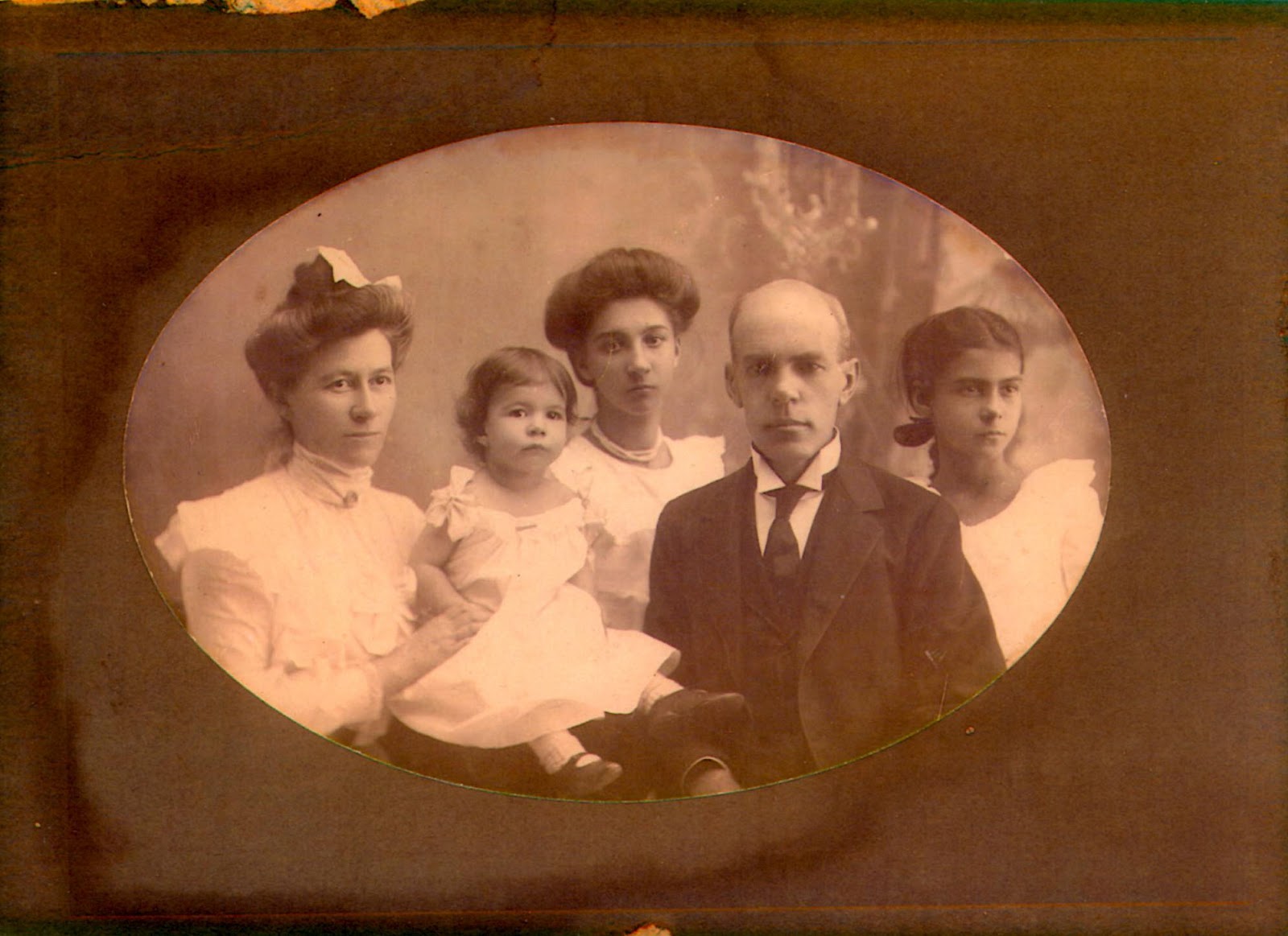
This is a photo of Carl's family. The woman on the left is Big Hattie, the grandmother he lived with. The sad-eyed girl in the middle is "Sister," his aunt, also named Hattie, who raised him after his father left. The very pretty girl on the right is Marguerite, his mother.
Thursday, August 16, 2012
Baby pictures
As part of this project, I raided my father's house today for all the photos and other stuff I could lay hands on. Here are a few baby pictures from his photo album. It is impossible to see Carl's face in one of the photos, which is damaged, possibly due to wear and tear, but also possibly due to my great-aunt, who unfortunately destroyed many Kraft family photos in a bout of angry senility. The woman is Carl's mother, Marguerite Wilkerson Kraft (my middle name is Marguerite, after her). The man is his father, Jerome Carr (or possibly Carl) Kraft. The pictures are dated 1918.
Subscribe to:
Posts (Atom)